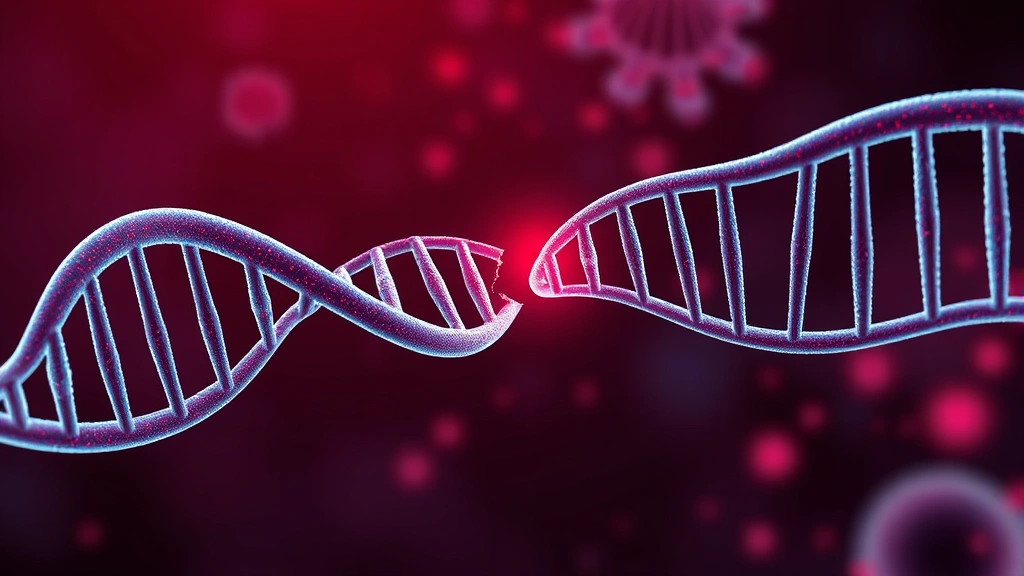
Cancer cells may sabotage their own DNA in the very act of growing, according to research that could expose a hidden weakness in tumours.
Scientists at the Hebrew University of Jerusalem found that cancer cells switch on super-enhancers — powerful stretches of DNA that crank growth genes to extreme levels. Running those genes so hard puts physical strain on the DNA, causing double-strand breaks. Published August 2, 2026 in Science Advances.
What a super-enhancer is
Enhancers are regulatory stretches of DNA that increase transcription of nearby genes. They work by binding proteins that recruit the transcription machinery, and every cell uses thousands of them to set which genes run at what level.
A super-enhancer is an unusually large cluster of enhancers acting together, densely occupied by regulatory proteins and producing transcription rates far above ordinary levels. They typically control the genes defining a cell’s identity, and cancers frequently acquire them at genes driving proliferation.
Why extreme transcription damages DNA
The physical mechanism is mechanical, and it follows from how DNA is structured.
DNA is a double helix. Transcribing it requires the strands to be separated so the machinery can read one, and because the molecule is twisted, unwinding it at one point over-winds it ahead and under-winds it behind — generating torsional stress in a long molecule anchored at both ends.
Cells relieve that with enzymes that cut, unwind and rejoin the DNA. Under normal transcription rates the system keeps pace. Under the extreme rates a super-enhancer drives, stress accumulates faster than it can be relieved, and the molecule breaks.
Transcription and DNA replication also collide when both machineries traverse the same region, and heavily transcribed regions in dividing cells experience that repeatedly.
The mutation cycle
Repeated cycles of breaking and imperfect repair then seed new mutations in exactly these highly active regions.
Double-strand breaks are the most dangerous DNA damage, and cells repair them by two main routes. One uses an intact copy as a template and is accurate; the other joins the ends directly and frequently loses or adds a few bases at the junction.
The direct-joining route is faster and available throughout the cell cycle, so it handles many breaks — introducing small errors each time. Break the same region repeatedly and mutations accumulate there specifically.
Which means the genes a cancer depends on most are the genes mutating fastest.
A double-edged strategy
“Cancer cells rely on super-enhancers to keep growth genes running at high speed,” said Professor Rami Aqeilan. The strain helps tumours in the short term but, the authors note, “increases mutation risk fueling cancer’s evolution” — potentially making tumours more adaptable and harder to treat over time.
That connects a mechanism to a clinical observation. Tumours evolve under treatment, developing resistance through new mutations, and this proposes a specific source of the variation that evolution acts on: not merely random damage, but damage concentrated in the regions that matter most for growth.
Why it could be a vulnerability
“Because cancer cells depend on these high-stress DNA regions to keep growing, they may also be more vulnerable there,” said researcher Osama Hidmi.
The team suggests future therapies could disrupt super-enhancer activity or block the DNA repair that tumour cells rely on to survive the damage they inflict on themselves.
The second approach has an established precedent. Drugs inhibiting DNA repair already work in cancers with existing repair defects, on the principle that a cell managing damage with reduced capacity dies when that capacity is removed. Extending it to cells generating more damage than normal — rather than repairing it less well — is the same logic from the other direction.
The limits
Normal cells also transcribe genes heavily and also repair breaks, so a repair inhibitor would affect them too — and whether the difference in damage load is large enough to give a therapeutic window is what would determine feasibility.
Why mutations cluster where they do
This finding contributes to a longer effort to explain why cancer genomes are not randomly damaged.
Sequencing large numbers of tumours revealed that mutations are distributed very unevenly across the genome. Some regions carry far more than others, and the pattern was initially puzzling — if damage were random and repair uniform, the distribution should be roughly flat.
Several explanations have emerged. Regions replicated late in the cell cycle accumulate more mutations, apparently because repair capacity is depleted by then. Densely packed chromatin is repaired less efficiently than open regions, because the machinery cannot access it as readily.
Transcription-associated damage adds a mechanism pointing the opposite way — toward the most open, most active regions rather than the most inaccessible ones. That matters because those regions contain the genes that determine how a cell behaves.
The practical consequence is for interpretation. Distinguishing mutations that drive a cancer from those that merely accumulated requires knowing the background rate at each position, and a region mutating frequently for mechanical reasons will produce apparent driver mutations that are nothing of the kind.
The findings are mechanistic and early, but they point to a fresh angle on why cancers mutate and how they might be attacked. Research news, not medical advice.