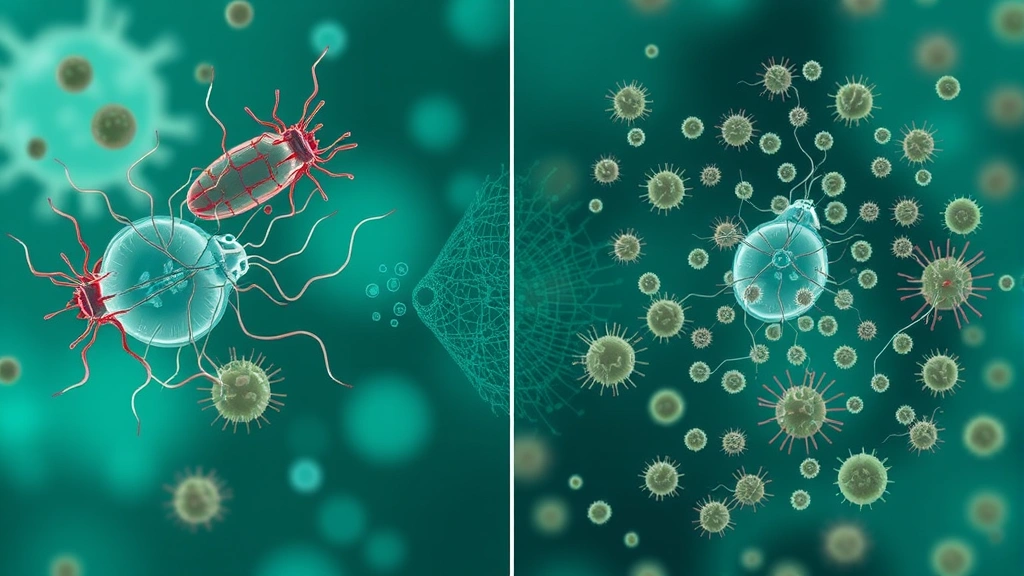
Doctors have combined two unconventional treatments — viruses that kill bacteria and a faecal microbiota transplant — to tackle recurrent urinary tract infections, with encouraging but very preliminary results.
Researchers at Fraunhofer ITMP at University Hospital Cologne, with Balgrist University Hospital in Zurich, treated three women with chronic, hard-to-treat UTIs caused by E. coli. Published in Nature Microbiology.
What phage therapy is
Each patient received phage therapy — bacteria-killing viruses given orally and directly into the bladder for eight days.
Bacteriophages are viruses that infect bacteria exclusively. They attach to specific receptors on a bacterial surface, inject their genetic material, replicate inside and burst the cell open. They are the most abundant biological entities on Earth and are the natural predators keeping bacterial populations in check.
Their therapeutic appeal is specificity. An antibiotic kills broad swathes of bacteria including beneficial ones; a phage kills only strains carrying the receptor it recognises. That precision is also the limitation — treatment requires identifying the infecting strain and matching a phage to it, which is closer to bespoke manufacturing than to dispensing a drug.
Why add a faecal transplant
Two of the three also received an FMT to restore healthy gut microbes that can harbour resistant bacteria between infections.
The rationale addresses why these infections recur. Most UTIs are caused by E. coli originating in the gut, which reaches the urinary tract by proximity. The gut is the reservoir, and treating the bladder alone leaves it intact.
Repeated antibiotic courses make this worse. Each course disrupts the gut community, and resistant strains that survive occupy the space cleared — so treatment progressively selects for a reservoir of exactly the organisms that will cause the next infection.
Replacing that community with one from a healthy donor targets the source rather than the episode, which is why combining the two approaches is more logical than either alone.
What happened
The two patients who received the combined therapy saw long-term reductions in UTIs over roughly two years, while the one who received phages alone still had episodes, though with milder symptoms.
All three substantially cut antibiotic use and reported better quality of life, with no side effects noted.
The pattern is at least consistent with the reservoir hypothesis: clearing the bladder without addressing the gut produced partial benefit, and doing both produced durable benefit. With one patient in each arm, the observation is suggestive and nothing more.
Why recurrent UTI needs alternatives
The condition affects a substantial number of women and is managed largely with repeated antibiotics, sometimes taken continuously as prophylaxis for months or years.
That approach works progressively less well. Resistance accumulates, options narrow, and some patients reach a point where few oral antibiotics remain effective — requiring intravenous treatment for what should be a routine infection.
It is also a condition that receives less research attention than its burden warrants, which is part of why unconventional approaches are being explored here.
The caveats, stated plainly
The researchers are blunt: “Three patients are not a sufficiently large sample to establish this new therapy, and control groups were lacking.”
The absence of controls matters particularly for this condition. Recurrent UTI fluctuates naturally — periods of frequent infection alternate with quieter spells — and patients typically enrol when symptoms are at their worst. Improvement afterwards is expected regardless of treatment.
Two years of follow-up partly mitigates that, since natural fluctuation over so long a period is less likely to account for sustained benefit. It does not replace a control group.
What comes next
At a time when antibiotic resistance is rising, the approach is intriguing enough that a proper clinical trial — the EU-funded REPhRAME project — is scheduled to begin in June 2027.
Why phage therapy stayed on the margins
Bacteriophages were used therapeutically before antibiotics existed, and the reasons the approach faded illuminate the obstacles it still faces.
Phage therapy developed in the early twentieth century and continued in parts of Eastern Europe throughout the antibiotic era, where treatment centres have used it continuously for decades. Elsewhere it was abandoned once antibiotics arrived, because a broad-spectrum pill that works against most bacteria is simply easier than matching a virus to a strain.
Regulation compounds that. Approval frameworks are built around a defined product with consistent composition, and phage therapy is frequently personalised — the preparation differs between patients and may be adjusted mid-treatment as bacteria evolve resistance. That is closer to how an individualised cell therapy is handled than how a drug is, and the pathway is unsettled.
Commercial incentive is also weak. Naturally occurring phages are difficult to patent, and a treatment tailored per patient does not scale into a conventional product — which is why most progress has come from academic centres and public funding, as it has here.
Designing it will require solving the blinding problem, since neither intervention is easy to mimic convincingly with a placebo. For now, it is a promising signal, not a proven treatment. Research news, not medical advice.