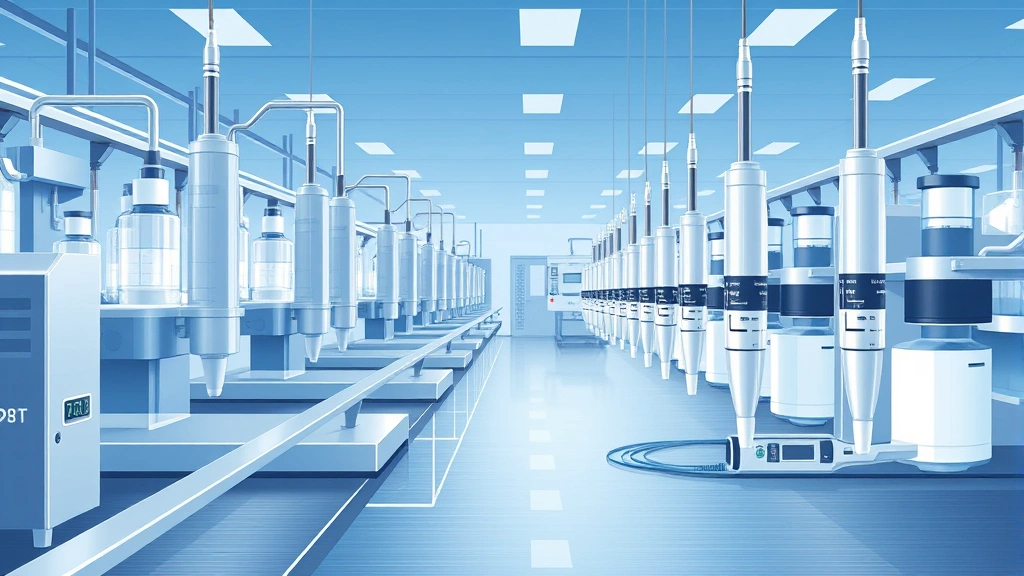
Contract manufacturer National Resilience and Eli Lilly are pouring another $750 million into a manufacturing operation in Ohio, aiming to shore up the US supply of injectable diabetes and obesity medicines.
The joint investment expands Resilience’s advanced manufacturing in the Cincinnati region to assemble Lilly’s KwikPen injectable device. Full operations are expected in early 2027, creating at least 400 new jobs — pushing Resilience’s Ohio headcount past 1,400. The company, headquartered in Blue Ash, Ohio, already runs two regional facilities employing close to 1,000 people.
Why device assembly is its own bottleneck
The investment targets assembly of the injector rather than production of the drug, and the distinction matters.
An injection pen is a precision mechanical device containing a cartridge of drug, a dose-setting mechanism, a spring-driven delivery system and a needle assembly. Manufacturing it is high-volume precision engineering closer to consumer device production than to pharmaceutical chemistry.
It is also regulated as part of the drug product, so assembly lines must meet pharmaceutical quality standards, be validated and qualified, and be inspected. That combination — consumer-scale volumes under pharmaceutical-grade control — is genuinely difficult, and capacity for it has been a real constraint independent of how much drug substance exists.
Why the pen format matters clinically
The device exists because self-administration requires it.
A patient injecting weekly at home cannot reasonably draw a dose from a vial with a syringe — it requires technique, invites dosing error, and deters people who are uncomfortable with needles. A pen sets the dose mechanically, conceals the needle, and reduces the procedure to pressing a button against the skin.
For a medication taken indefinitely by a large population, that difference determines whether people continue treatment.
Why now
Demand for injectable diabetes and weight-loss treatments has strained supply across the industry.
The shortages of recent years had multiple causes at different points in the chain — peptide synthesis capacity, fill-finish operations placing drug into cartridges, and device assembly. Expanding one without the others simply relocates the constraint.
The two companies say their partnership, established in 2023, has already produced more than 150 million doses in vial and pre-filled-syringe formats for US patients; the new money scales the device-assembly side of that pipeline.
Why use a contract manufacturer
Lilly could build this capacity itself, and partnering has specific advantages.
Speed is one: an existing operator with trained staff, established quality systems and regulatory experience can add a line faster than a new site can be built.
Risk allocation is another. Demand for these medicines is expanding rapidly and could plateau, and capacity built directly becomes a fixed cost carried indefinitely. Capacity contracted from a partner is easier to adjust, and the partner can serve other customers if volumes fall.
A joint investment of this size sits between the two models — more committed than a straightforward supply contract, less permanent than building alone.
Part of a reshoring push
The deal lands amid a broader drive to bring more drug production back to the United States.
Resilience chief executive William Marth said the investment shows how “trusted partnerships, operational excellence, and disciplined execution can strengthen America’s medicine supply,” while Lilly’s manufacturing chief stressed that scaling complex programmes demands “proven technical capability” and “an uncompromising commitment to quality.”
What 400 jobs represents
The employment figure is higher relative to investment than in most pharmaceutical manufacturing, and the reason is the nature of the work: device assembly involves more handling, inspection and packaging steps than the highly automated chemical or biological production of the drug itself.
What the contract manufacturing sector looks like now
Resilience’s position is worth understanding, because the company represents a particular bet on how pharmaceutical manufacturing should be organised.
It was founded during the pandemic on the premise that US biomanufacturing capacity was dangerously thin and that a well-capitalised operator could build a national network. It raised extraordinary sums quickly and acquired facilities rapidly.
The subsequent period tested that thesis. Building manufacturing capacity is capital-intensive with long payback, and demand for contract manufacturing fluctuates with biotech funding cycles — which turned sharply down after the pandemic-era peak. The sector saw consolidation and retrenchment.
What has proved durable is capacity tied to specific high-volume products rather than speculative general capability. A dedicated line assembling one customer’s device, funded jointly by that customer, carries a fundamentally different risk profile from capacity built in advance of demand.
The structure of this deal reflects that lesson. It is closer to a committed partnership than to a contract manufacturer speculatively adding capacity, which is what the sector learned to prefer.
It is also the part of the process most amenable to further automation, which is worth noting when such figures are cited. Business news, not investment advice.