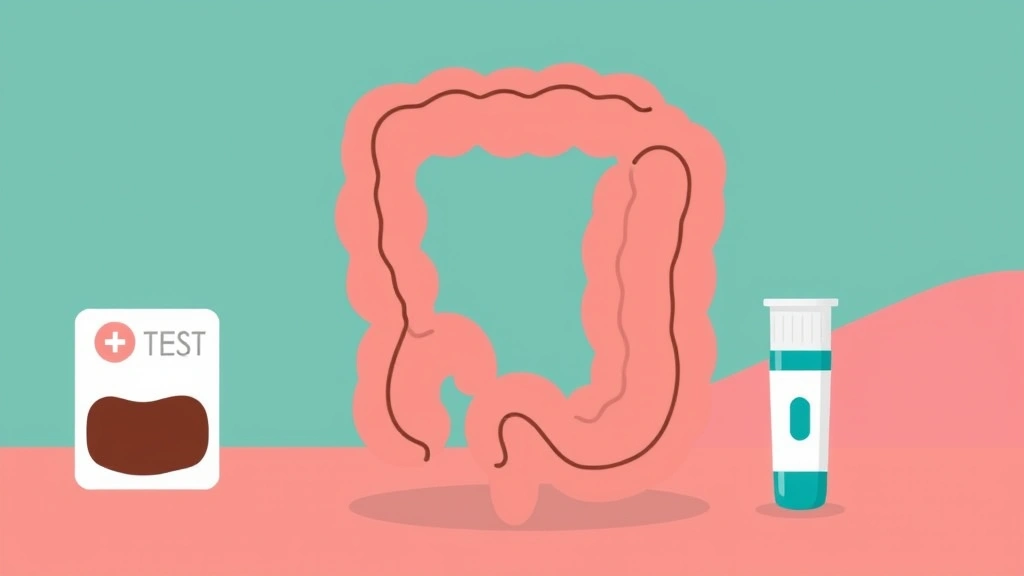
One of the simplest cancer-screening tools — a stool test done at home and mailed back — was linked to a large drop in colorectal cancer deaths.
Researchers at Sweden’s Karolinska Institutet and Umeå University followed 376,511 people in the Stockholm-Gotland screening programme, using a faecal occult blood test that checks stool for tiny, invisible amounts of blood. Over up to 14 years, people who participated had a 43% lower risk of dying from colorectal cancer than those invited who did not take part. The findings were published in JAMA Network Open.
Why colorectal cancer is worth screening for
Colorectal cancer has a feature that makes it unusually suited to screening: it typically develops slowly from precancerous polyps over years before becoming invasive.
That long window means screening can catch the disease early, when treatment is far more effective, and in some cases prevent it entirely by identifying polyps for removal before they become malignant. Few cancers offer both possibilities.
The disease is also common, and outcomes depend heavily on stage at diagnosis — early-stage colorectal cancer is highly treatable, while advanced disease is frequently not.
How the test works
Faecal occult blood testing detects blood in stool that is not visible. Polyps and tumours tend to bleed intermittently in quantities too small to see, so the test is looking for an indirect sign rather than the cancer itself.
It is not diagnostic. A positive result triggers colonoscopy, which is where cancer is actually found or excluded — the stool test is a filter determining who needs the invasive procedure.
That filtering role is what makes population screening feasible. Colonoscopy for everyone would be prohibitively expensive, uncomfortable and carry procedural risk; a cheap home test identifying a smaller group who need it is the practical alternative.
The invitation-versus-participation distinction
The two figures matter differently, and the gap between them is instructive.
Simply being invited to screen was associated with 26% lower death risk. Actually completing the test was tied to the larger 43% reduction.
The invitation figure is the more conservative and arguably more useful number for policy, because it measures what a programme achieves across everyone it reaches, including those who ignore it. It is the effect a health system actually buys.
The participation figure describes what an individual who takes part experiences — and it is inflated by the fact that people who complete screening differ from those who do not.
The one-third who did not respond
About a third of eligible people did not submit a sample, which is the programme’s main limitation and the gap between its two numbers.
A screening programme only works if people use it, and the reasons for non-participation are varied — the test is unappealing, the mailing is easily set aside, some people avoid health services generally, and some do not receive or understand the invitation.
Non-participation is also socially patterned, concentrating among groups already experiencing worse health outcomes — which means screening programmes can widen inequalities even while improving population averages.
The confounding caveat
This was an observational study, and the authors note the estimates “depend on statistical adjustments designed to account for different sources of bias, so some uncertainty remains.”
The core problem is that people who choose to screen differ from those who do not. They tend to be more health-engaged, more likely to seek care for symptoms, less likely to smoke and more likely to attend other preventive services — all independently associated with better cancer outcomes.
Some of the 43% therefore reflects who participates rather than what participation does. Randomised trials of faecal occult blood screening have been conducted and found mortality benefit, which anchors the finding — this study describes the effect in a real programme rather than establishing that screening works.
What 14 years adds
The follow-up length is a genuine strength. Cancer screening benefits accrue slowly, since the disease being prevented takes years to develop and kill, and short-term studies systematically understate the effect.
Fourteen years is long enough to capture deaths that early detection actually prevented rather than merely delayed.
The practical message
Stool tests are cheap, non-invasive and done at home — requiring no bowel preparation, no sedation, no time off work and no procedure.
How stool testing compares with colonoscopy
Screening programmes choose between approaches, and the trade-off is not simply that one is better.
Colonoscopy examines the bowel directly and can remove polyps during the same procedure — detecting and preventing in one step. It is the most sensitive option and requires bowel preparation, sedation, time off work and carries a small risk of perforation or bleeding.
Stool testing detects far less and is done at home for a fraction of the cost, with no preparation and no procedural risk. It must be repeated regularly — typically every one to two years — because it catches bleeding lesions at the moment of testing rather than surveying the whole bowel.
The decisive variable is participation. A less sensitive test that most people complete can prevent more deaths across a population than a highly sensitive one that many decline, and this study’s one-third non-response rate is high for a test requiring only a posted sample. Programmes generally choose stool testing as the first step precisely because the participation gap between the two is larger than the sensitivity gap.
The results reinforce a consistent message: participating in recommended colorectal screening saves lives, and the barrier is not test performance but the third of people who never send the sample back. This summarises research and is not medical advice; talk to your doctor about the right screening for you.