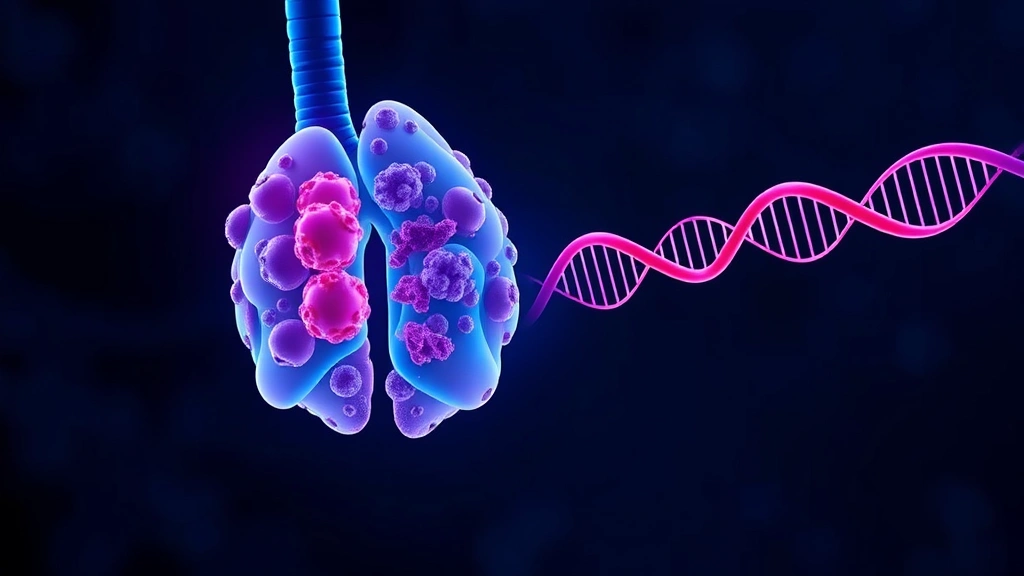
Researchers have found that combining two cancer drugs with complementary mechanisms hits non-small cell lung cancer harder than either alone — by both damaging tumour DNA and blocking the cancer’s ability to repair it.
The combination pairs HER3-DXd (patritumab deruxtecan), an antibody-drug conjugate delivering a DNA-damaging payload to cancer cells, with olaparib, a PARP inhibitor blocking a key DNA-repair pathway. The study was published in Cell Reports Medicine.
The logic of the pairing
The strategy is mechanistically clean, which is why it is worth taking seriously despite being preclinical.
An antibody-drug conjugate works like a guided weapon: an antibody recognising a protein on the cancer cell surface — here HER3 — carries a potent payload and releases it inside the target cell. The payload in this class damages DNA severely enough to kill a cell that cannot repair it.
Cells can repair such damage, which is how tumours survive. PARP inhibitors block one of the pathways doing that repair.
Delivering damage while removing the repair capacity attacks a single vulnerability from two directions, and the effect should be more than additive — each drug makes the other harder to survive.
What HER3 offers as a target
HER3 is a member of the same receptor family as HER2 and EGFR, and it is expressed across a broad range of lung cancers rather than defining a narrow subgroup.
That breadth is what makes it attractive for an antibody-drug conjugate. The antibody does not need to block a growth signal; it needs to bind something present on the tumour and get inside. A widely expressed surface protein is a good address even if targeting it therapeutically would achieve little.
The results
In laboratory models, the pairing increased DNA damage, triggered cancer-cell death, and slowed tumour growth.
Crucially, it worked across multiple genetically distinct forms of lung cancer and “was not dependent on any specific mutation,” said lead researcher Dr Heidi Haikala of Tampere University, whose team included collaborators from Helsinki, Harvard Medical School and Dana-Farber.
Why mutation-agnostic matters
Lung cancer treatment has become heavily stratified by molecular subtype — drugs matched to specific driver mutations, which work well for the patients who carry them and not at all for those who do not.
That has been enormously beneficial and leaves substantial gaps. Many patients have no targetable driver, and those who do eventually develop resistance and exhaust the matched options.
A combination whose effect does not depend on a specific mutation could in principle serve across those groups. The mechanism explains why: DNA damage and repair are universal cellular processes rather than features of a particular oncogenic pathway.
The unexpected immune finding
The combination also switched on the cGAS-STING innate immune pathway, boosting natural killer cell-mediated tumour killing.
This is coherent rather than coincidental. cGAS-STING evolved to detect DNA in the cell’s cytoplasm, where it should not be — a reliable signature of viral infection. Severely damaged chromosomes produce DNA fragments that end up in the same place, so the cell’s antiviral alarm fires in response to genomic catastrophe.
Triggering it turns a tumour that immune cells were ignoring into one they recognise. A combination that kills cancer cells directly and simultaneously recruits immune attack is doing two useful things from one intervention.
The caveats the researchers state
This is preclinical work in tumour organoids and mice. Only a limited number of organoid lines were tested, which matters given the claim of mutation-agnostic activity — demonstrating breadth requires breadth, and a handful of lines is a modest basis for it.
The immune findings may not generalise, and this deserves emphasis. Mouse immune systems differ substantially from human ones, and cGAS-STING responses in particular vary between species.
The toxicity question
Potential toxicities — including liver effects — need careful evaluation before human trials, and this is the most substantive obstacle.
Both components have known tolerability constraints. Antibody-drug conjugates in this class carry recognised risks including lung inflammation, and payload released outside the tumour affects healthy tissue. PARP inhibitors independently cause blood count suppression and fatigue.
Why lung cancer keeps attracting combination strategies
Non-small cell lung cancer is the setting where combination approaches are tested most intensively, for reasons worth understanding.
It is common, which means trials can enrol. It is genetically well characterised, so patients can be stratified. And critically, it has a large population of patients who have exhausted their options — targeted therapy for those with drivers, immunotherapy and chemotherapy for those without — and who still have reasonable performance status.
That combination of features makes it the natural proving ground. A regimen demonstrating activity in previously treated lung cancer can move quickly toward registration, and success there frequently opens paths into other tumour types.
The corollary is that the bar keeps rising. Each successive advance means the next candidate must show benefit on top of a better standard of care, in patients who have already received more treatment — which is why mechanistically novel combinations attract attention over incremental additions to existing regimens.
Combining agents that each damage DNA and each stress the same organs raises a real possibility that the therapeutic window narrows faster than the anti-tumour effect grows — which is how many mechanistically elegant combinations have failed. Preclinical research; not medical advice.