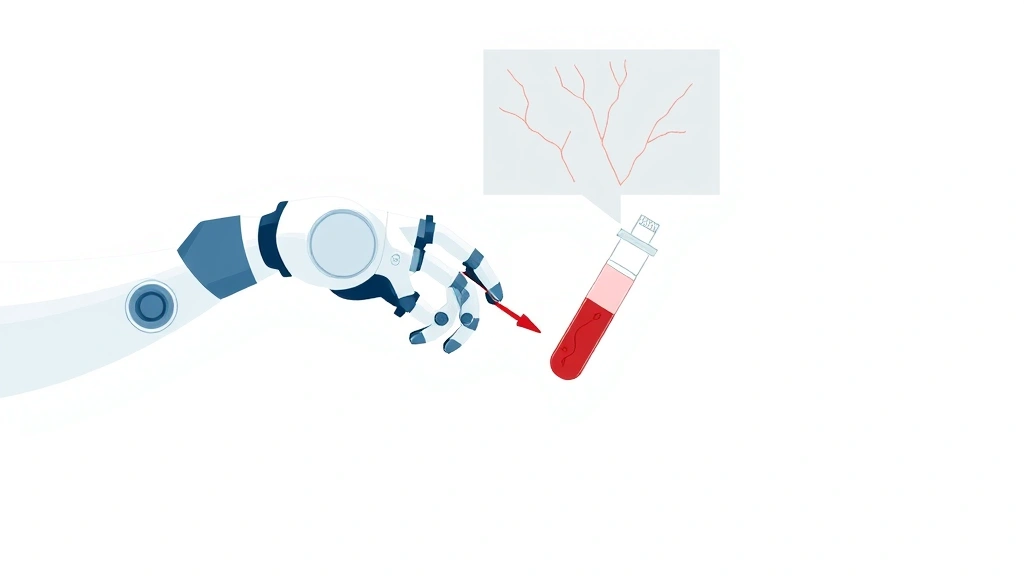
The FDA has authorised Aletta, from Vitestro — the first standalone robotic device that can draw blood from a patient’s arm without hands-on operator intervention.
Cleared on August 19, 2026 through the De Novo pathway, Aletta autonomously locates a suitable vein and performs most of the blood draw while a trained phlebotomist supervises — and can oversee up to three devices at once. It is authorised for adults in outpatient settings.
Why blood draws are harder than they look
Venepuncture appears routine and is a skilled procedure with a meaningful failure rate.
Finding a suitable vein depends on anatomy that varies enormously between people and is frequently invisible — obscured by body habitus, oedema, or simply sitting deep. Veins roll away from the needle, collapse under suction, or prove too fragile in older patients and those who have had repeated draws.
The consequences of failure are not trivial. Repeated attempts are painful and distressing, and failed draws delay diagnosis and treatment. Patients described as having “difficult access” — frequently those needing blood tests most often — accumulate considerable unpleasant experience.
What the robot brings
A machine can use imaging to locate veins that a human cannot see, and can position and advance a needle with consistency that does not vary with fatigue or experience.
That is the plausible source of the reported performance: in FDA-reviewed clinical testing, successful blood-draw rates were comparable to or better than trained human phlebotomists.
“Comparable to or better than” is the standard a device like this must meet. A robot that is merely adequate solves nothing, since the procedure is not difficult enough to justify automation for its own sake — the case rests on doing it at least as well while requiring less staff time.
The safety design
If a patient moves too much during the procedure, the needle automatically detaches and the draw stops. Onboard sensors can also pause the procedure and alert the supervisor if other unsafe conditions are detected.
The detaching needle is the critical feature, and it addresses the obvious hazard. A needle rigidly held by a machine while a patient jerks their arm is a laceration; one that releases is a failed draw. Designing the failure mode to be benign is what makes autonomous operation defensible.
The supervision model
One phlebotomist overseeing three devices is where the value is, and it is worth being precise about what that means.
This is not removing the professional. It is changing what they do — from performing each draw to monitoring several, intervening when a device flags a problem, and handling patients the machines cannot manage.
The realistic gain is roughly tripling throughput per staff member for routine outpatient draws, in a context where many health systems face a phlebotomist shortage. Whether that materialises depends on how often devices require intervention, since a machine needing frequent assistance consumes the supervision capacity that made it worthwhile.
The scope limits are deliberate
Authorisation covers adults in outpatient settings under supervision by someone trained in phlebotomy — and each restriction is doing work.
Adults excludes children, where veins are smaller, cooperation is unreliable and the procedure is genuinely harder. Outpatient excludes inpatients, who are sicker, frequently have poor venous access and may be unable to cooperate. Both exclusions carve out precisely the populations where automated draws would be most difficult and least safe.
The result is authorisation for the easiest version of the task — which is also the highest-volume one, and therefore where automation delivers most.
What De Novo signifies
The De Novo pathway is used for new types of low-to-moderate-risk devices with no existing predicate to claim equivalence to. As with other first-of-kind authorisations, it creates a classification subsequent devices can reference.
That matters for the category. A second entrant no longer faces the burden of establishing an entirely new device type, which historically has been the main deterrent to competition in novel areas.
The realistic assessment
Blood draws are among the most common medical procedures, so even modest efficiency gains multiply. A device letting one professional supervise several machines could help stretch scarce staff.
Where healthcare automation has actually worked
Robotic blood draw joins a specific category of healthcare automation, and the pattern of what succeeds is informative.
Laboratory automation has been transformative — sample handling, analysis and result reporting are now largely machine work, and the change happened without controversy because the tasks are repetitive, well defined and performed on specimens rather than people. Pharmacy dispensing robots followed the same path.
Automation touching patients directly has fared less well. Surgical robots remain instruments a surgeon controls rather than autonomous systems, and attempts at more independent operation have moved slowly.
Venepuncture sits between those categories: a physical procedure performed on a person, but a highly standardised one with a clear success criterion and a benign failure mode. That combination is what makes it the plausible next step, and it suggests where automation will spread next — toward procedures that are repetitive and standardised rather than toward those requiring judgement.
It is authorised as a supervised tool, not a replacement for trained personnel — and the patients who most need skilled phlebotomy are precisely the ones the authorisation excludes. Regulatory and device news.